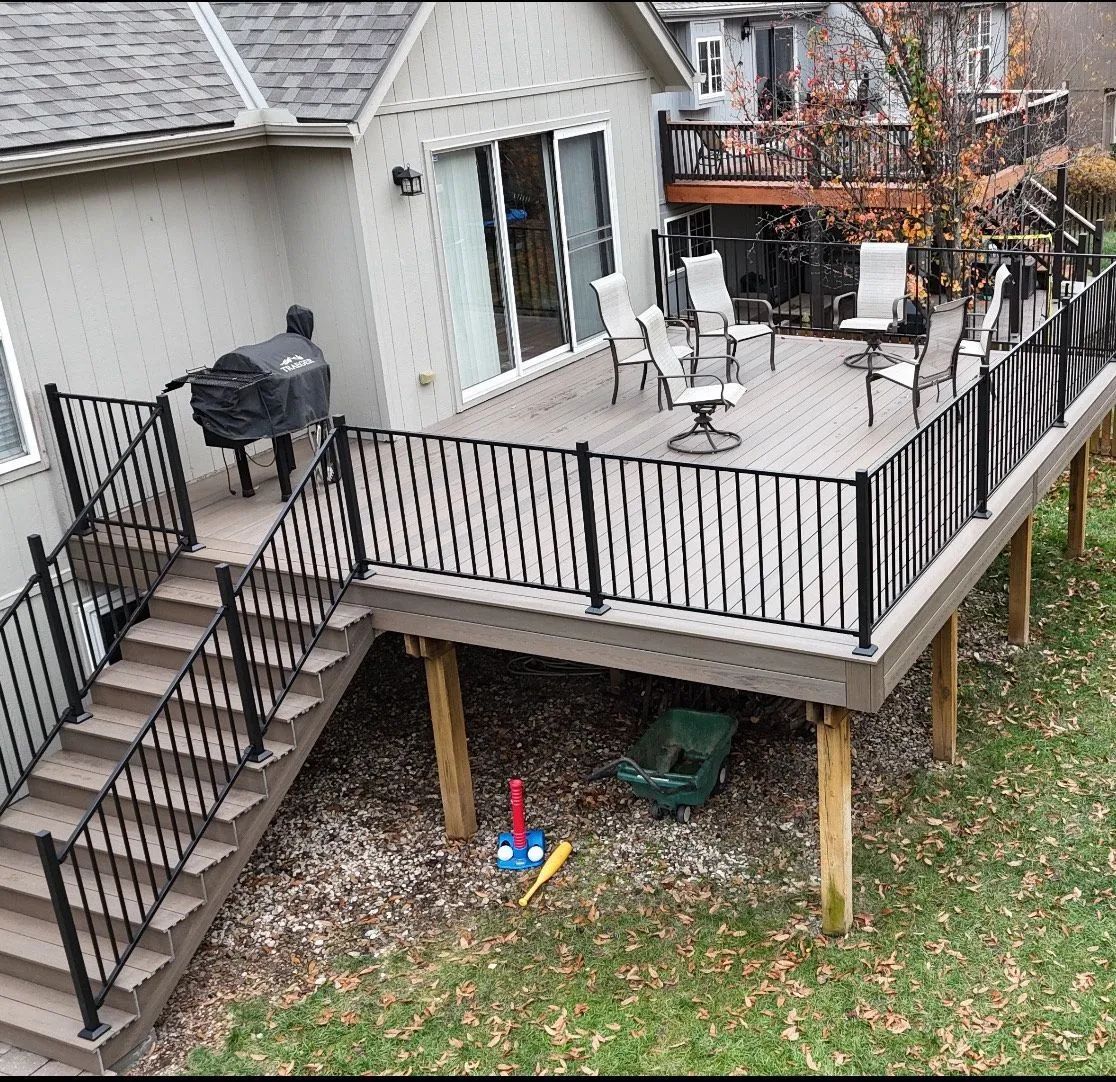
Deck Feels Bouncy or Wobbly Underfoot? What's Going On With the Framing
You're carrying a tray of burgers off the grill, and halfway across the deck you feel it, a soft give underfoot, almost like walking on a trampoline that's lost some air. Or maybe it's the railing. You lean on it to watch the kids in the yard and it shifts a little more than a railing should. The first time it happens, you tell yourself it's nothing. The second or third time, you start paying attention to which boards you step on and which ones you avoid.
That give isn't in your head, and it isn't something a coat of stain or a few extra screws in the decking is going to fix. Deck boards themselves rarely cause bounce. What you're feeling is the structure underneath responding to your weight, and it's telling you something about how the frame was built or how it's held up over time. In the Kansas City area, where summer heat, winter freeze-thaw, and clay soil all put their own stress on a deck's structure, that movement often has a specific, findable cause.
Quick Answer: A bouncy or wobbly deck almost always comes from the framing, not the surface boards. The usual suspects are joists that are undersized or spaced too far apart for the span, joist hangers that are missing, corroded, or improperly nailed, a ledger board connection that's loosened or is rotting where it meets the house, or a post footing that has shifted from freeze-thaw heave or settling in clay soil. Diagnosing which one is at work means getting underneath the deck and checking each connection point, not just looking at the surface.
What "Bouncy" Actually Means in a Deck Frame
Every deck flexes a little under load. Wood and composite decking are both designed to deflect slightly when you walk on them, and that's normal. The problem is when the flex is noticeable, when it happens with light loads like a single person walking, or when it's paired with a spongy or springy feeling that gets worse the farther out you walk from the house.
That kind of deflection means the joists supporting the deck boards are bending more than they should, and a joist that bends too much under normal weight is either too small for the distance it spans, spaced too far from its neighbors, or not properly connected at one or both ends. Wobble, as opposed to bounce, usually points somewhere else: a post that's no longer sitting square on its footing, a beam connection that's loosened, or a railing post that's lost its grip in the frame below the decking. Both symptoms trace back to the same place, the structural skeleton hidden under the boards you walk on.
You can't diagnose either one from the top.
Undersized or Overspanned Joists
This is the most common reason a deck feels bouncy, and it's baked in at construction. Joist size, spacing, and span all work together, and building codes set maximum spans for each combination based on the lumber species and grade being used. A 2x8 joist can only safely span so far before it needs another support, and that maximum distance shrinks as the spacing between joists gets wider.
Spacing That's Too Wide
Standard wood decking typically uses joists spaced 16 inches on-center, while composite decking often requires 12-inch spacing because it flexes more. Wider spacing can make boards feel soft, regardless of framing quality.
Joists Sized For The Wrong Span
A joist spanning farther than its size allows will deflect noticeably, even with properly installed hangers and fasteners. This design issue commonly appears when decks are extended, modified, or built without proper engineering.
Cantilevers Pushed Too Far
Deck framing can extend beyond the last beam to create an overhang, but cantilevers have limits based on joist span. Extending them too far causes noticeable bouncing near the deck's outer edge underfoot.
Missing or Failing Joist Hangers
Joist hangers are the metal brackets that carry the load from each joist into the ledger board or beam. Small parts, and they carry more than their size suggests. It's common to find several ways they've gone wrong on an older or lower-quality deck.
Gaps Between The Joist And The Hanger
A properly seated joist sits tightly against the hanger's back. If a gap exists, the joist can shift under load before contacting the hanger, creating movement and bounce. Visible daylight beyond a hairline gap warrants inspection for proper support.
The Wrong Fasteners
Hanger manufacturers specify nails based on size, length, and shear strength. Substituting screws or shorter nails can leave connections under-fastened. Over time, repeated flexing may loosen these fasteners, allowing the hanger connection to weaken or potentially pull free.
Corrosion
Pressure-treated lumber contains chemicals that can react with standard steel hangers and fasteners. Components contacting treated wood should be properly rated, typically hot-dip galvanized or stainless steel. Untreated hardware can corrode internally, weakening connections before significant surface rust becomes visible.
Hangers Left Out Altogether
Some decks, particularly unpermitted additions or repairs, have joists toe-nailed directly into ledgers or beams instead of using hangers. These connections provide significantly less holding strength and can loosen gradually with seasonal expansion, contraction, and repeated movement.
TIP: If you can get under the deck, run your hand along the bottom of each joist where it meets the ledger or beam. A hanger with rust streaks bleeding down the wood, or one where you can wiggle a fastener with your fingers, has already started to fail even if the deck still feels mostly solid.
Ledger Board Problems at the House Connection
The ledger board is the framing member bolted to your house that the rest of the deck hangs from, and it carries more of the deck's total weight than any single beam or post. Because it sits tucked behind the decking and often behind siding, problems here can go unnoticed for years while they get worse.
Fastener And Flashing Issues
A ledger needs to be attached with lag screws or through-bolts sized for the load, not nails, and it needs flashing that keeps water from getting trapped between the ledger and the house wall. Decks built without that flashing, particularly older ones, are prone to chronic moisture behind the ledger, which leads to decay in both the ledger and the house framing it's attached to.
Movement At The House
Push gently on the outer edge of the deck toward the house and watch the ledger connection. Any visible flex or a gap that opens and closes means the fastener pattern has lost some of its holding power, whether from corrosion, wood decay, or fasteners that were undersized to begin with.
Water staining, rust streaks below the bolt heads, and soft or spongy wood when you press a screwdriver into the ledger face are all signs worth taking seriously. None of them mean the deck is about to collapse. And all of them mean the connection is weaker than it was designed to be, which typically shows up first as a soft, bouncy feeling near the house before it becomes anything more serious.
Posts and Footings Settling in Kansas City Clay
Framing problems aren't always about the lumber. Sometimes the frame is built correctly and the ground underneath it has moved. This is a particularly local issue in the Kansas City metro, where soils lean heavily clay and frost depth typically runs 30 to 36 inches.
Clay soil holds far more moisture than sandy or gravelly soil, and that moisture is what drives frost heave. As the ground freezes each winter, water in the clay expands and can push a footing upward. When it thaws, the footing may not settle back to exactly where it started, and a footing that wasn't poured deep enough to sit below the frost line in the first place is especially vulnerable to this cycle repeating year after year. A post that's shifted even half an inch off level changes how weight travels through the beam above it, and that change often shows up as new wobble in a deck that used to feel solid.
WARNING: A footing that has visibly heaved, cracked, or tilted is a structural issue, not a cosmetic one, and it's not something to shim or patch from above. If you can see daylight under a post base, or a post that used to sit plumb now leans, that footing needs to be evaluated and very likely reset below the frost line before the deck sees another freeze-thaw cycle.
Beyond frost heave, clay soil also shrinks and swells with normal moisture changes through a Kansas City summer and fall, expanding when wet and contracting hard during a dry stretch. Footings poured too shallow, undersized for the load above them, or lacking a proper flat, compacted base are more exposed to that seasonal movement, and it tends to show up first as a wobble at the post rather than anywhere else in the frame.
Missing Blocking Between Joists
Blocking is the short lumber installed perpendicular between joists, usually over the main support beam, and its job is to keep individual joists from twisting sideways under load. Without it, joists can rotate slightly when weight shifts across the deck, which lets the whole framing system flex more than it was designed to. A deck with blocking left out, or installed at the wrong spacing, often feels fine when you stand still but develops a rolling, springy sensation when several people move across it at once. It's an easy detail to skip during construction because it doesn't affect how the deck looks when it's finished, which is exactly why it's worth checking on a deck someone else built.
When Bounce Means It's Time to Call a Professional
A little give in a deck is normal. What separates a normal deck from one with a real framing problem is degree and pattern. If the bounce is noticeable under a single person's weight, if it's gotten worse over the past year or two, or if it's concentrated at a cantilevered edge or near the ledger, that's no longer something to watch and wait on.
But catching the warning signs yourself only gets you halfway there. Sistering an undersized joist or rebuilding a ledger connection means pulling decking, working with load-bearing lumber, and in most cases pulling a permit. Fix only the symptom you can see instead of the cause underneath it, and the same bounce comes back in a season or two.
A structural evaluation from someone who builds decks for a living beats a general contractor guessing at spans. That's not a knock on general contractors. It's just not what they do every day.
Frequently Asked Questions
Is a bouncy deck dangerous, or just annoying?
It depends on the cause. Mild deflection from wide joist spacing is mostly a comfort issue, but bounce from a failing hanger, cracked footing, or loosening ledger can progress to real structural failure over time.
Can I fix a bouncy deck myself?
Simple fixes like adding blocking or replacing corroded fasteners suit a confident DIYer. Anything involving the ledger, footings, or resizing joists is structural work affecting the whole load path, and mistakes stay hidden until loaded.
How do I know if it's the joists or the footings causing the wobble?
Bounce spread evenly across the surface, worse toward the outer edge, usually points to the joists. Wobble concentrated at one post, or a railing shifting in one spot, points to a footing or post connection.
Does composite decking cause more bounce than wood?
Composite boards flex more than solid wood between supports, so manufacturers call for tighter joist spacing. A deck built for wood at 16-inch spacing and later resurfaced with composite at that same spacing bounces noticeably.
Why does my deck feel worse in certain seasons?
Wood framing expands and contracts with moisture and temperature, so marginal connections like a loose hanger nail show more play during humid Kansas City summers and again after a hard freeze-thaw cycle in deep winter.
Do older decks need to be inspected even if nothing looks obviously wrong?
Framing problems like ledger corrosion and footing heave develop gradually and out of sight. A deck over ten to fifteen years old deserves a structural check, since catching a marginal connection early beats repairing failure.
What That Underfoot Give Is Really Telling You
A deck that has started to move underfoot is rarely reacting to the surface boards. The give traces back to a joist, a hanger, a ledger, or a footing, and the right fix depends entirely on which one gave way first. With 8 years of experience, KC Deck and Fence understands how decks across Overland Park, KS respond to shifting clay soil and the long freeze-thaw swings that arrive with every Kansas City winter, and where that movement usually begins.
The reason a framing problem deserves early attention is simple: it does not stay put. A loose hanger or a heaved footing shifts more load onto the connections beside it, and those neighbors begin to strain in turn. Catching that soft spot while it is still one soft spot keeps a comfort issue from quietly becoming a structural one, and it means the deck stays as steady on a crowded summer evening as it was the day it was built.